
Growing Photinia Red Robin Key Points:
Photinia is one of the most popular, easy-to-grow garden shrubs. P. 'Red robin' is one of the most commonly grown varieties.
Key Points:
Light: Photinia will grow in light shade but has the best leaf colour in full sun.
Height: Red Robin 4m can be contained by pruning.
Soil: Any provided its not to heavy/waterlogged.
Special Features: Easy to grow, moderately fast growth rate and dense leaves make it good for privacy/hedging. Photinia is versatile; you can grow it as a single specimen, a hedge or as a standard.

Photinia is tagged green wheelbarrow, indicating it is an easy to grow low maintenance shrub.
How to grow Photinia Red Robin
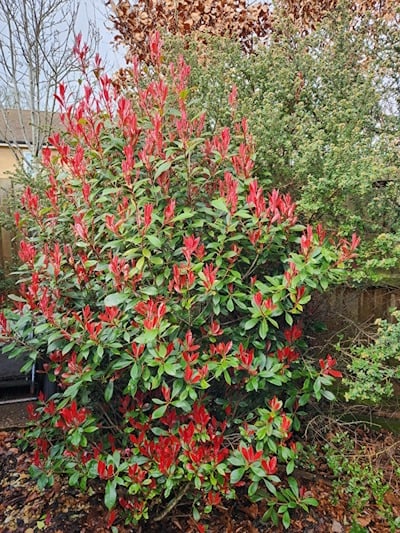
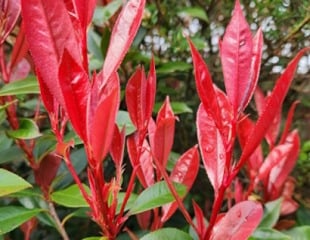
The most popular variety of Photinia is 'Red Robin'. Easy to grow, with lush evergreen foliage and startlingly bright red new growth in the spring, it is an ideal garden shrub.
P.'Red Robin' is relatively fast growing, up to around 30cms or 1' per annum in ideal growing conditions. Plant Photinia in good soil, neither boggy nor dry, and in sun or partial shade, but for the best leaf colour, grow Photinia in a sunny spot.
Photinia is fully hardy, H5, but chill winds can damage the bright red growth. Plant in a sheltered spot to protect the new growth. This image shows a healthy Photinia 'Red Robin' growing in a garden setting.
Photinia 'Red Robin' will reach up to 4m, and it can be checked by pruning. There is also a variety call P.'little red robin' which, as the name suggests, is compact to around 1m. You can grow Photonia 'Red Robin' as a hedge; it responds well to clipping, and you can train it into a standard/lollipop see below.
Affiliate links to buy Photinia Suttons have 11 varieties in varying sizes, including P. 'Red Robin'
Growing Red Robin as a Hedge
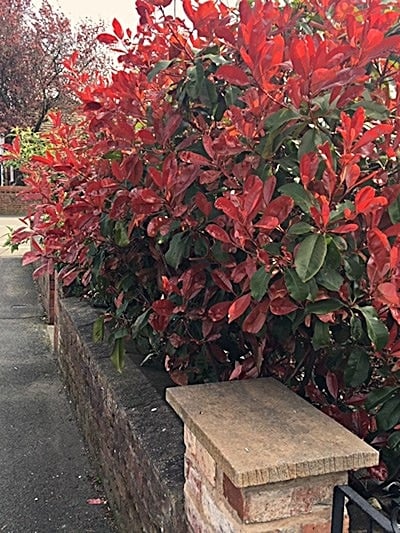
Photinia 'Red robin' makes a lovely colourful hedge. Being evergreen, it creates a good degree of privacy. It is not as dense as say, privet, so will form a looser hedge, but it is much more interesting.
How closely you plant the shrubs depends on a) the size of the plants you buy and b) how long you are prepared to wait for the hedge to fill out.
Obviously, the larger the shrub, the further apart it can be planted. So, say a 2L would be 3-5 plants per metre, whereas a 10L would be only two. If you are investing in a hedge, water, water, water after planting. The major cause of shrub failure is a lack of sufficient water during the first 12+ months. If you are growing Photinia as a hedge, to encourage it to produce more leaves, so it is thicker and not spindly, and to keep to size, prune regularly, more info below.
Photinia 'Red Robin' is one shrub that filters out pollution, helpful if you reside near a main road; there are others.
Growing Photinia as a standard
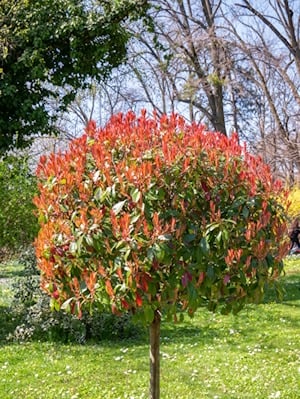
Photinia responds well to pruning and lends itself to being trained into a standard or lollipop shape.
You need to start with a small, immature shrub, preferably with just one stem. Younger shrubs are less likely to be multi-stemmed. Pick a straight stem and remove any other stems and foliage. As the shrub grows, maintain a single stem.
To maintain the top growth/lollipop shape, clip the shrub regularly, keeping it in a compact round shape. As a standard. Photinia 'Red Robin' can look attractive, planted as shown in the image on its own to display the lovely red leaves.
Pruning Photinia and Avoiding Leaf Spot
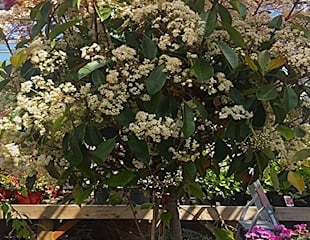
Routine pruning is carried out in the Spring, around March, to keep the shrub in shape and enhance the red fresh growth. Be aware that Photinia produces creamy flowers (see the image above) in late spring /early summer. If you prune all the growth in early spring, you will get good foliage, but no/reduced flowers. To get some flowers, stagger pruning to get a bit of both.
The other function of pruning, which is done in autumn/winter pruning, is to reduce the occurrence of leaf spot, a fungal disease to which P. Red Robin is prone.
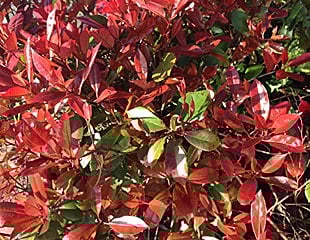
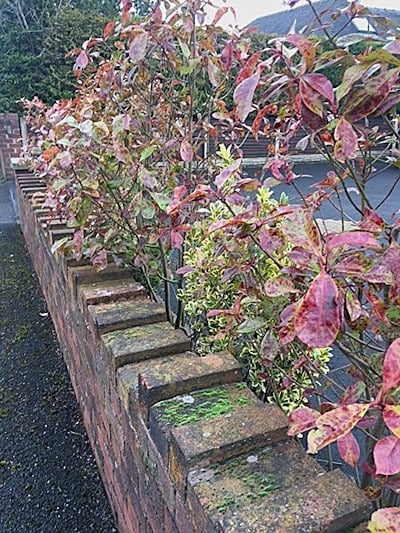
Contrast this red robin with the one above. This P. Red Robin hedge has leaf spot. Because it is a fungal disease, good air circulation can prevent/ameliorate it. The purpose of the autumn/winter prune is to open up the shrub by thinning out any dense growth in the centre and the lower part of the shrub, to allow greater air circulation. Leaf spot is also less common on shrubs grown in full sun.
I remember taking this image. I was walking around a housing estate and spotted sickly-looking Photinia suffering from leaf spot. I thought an ideal time to snap a Photinia in poor condition. The householder disagreed and shouted at me, forcing a hasty retreat!
After planting water, water, water!
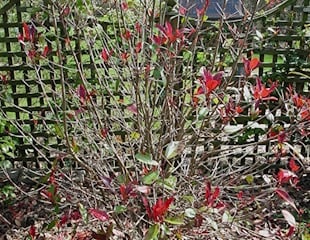
It is essential when you plant a new shrub, Photinia or any shrub, that you water, water and water again. I know we think we have had enough water with all the flooding, but even so, there are dry spells and new shrubs need water.
In this image, the newly planted Photinia did not get regular watering, and it dropped nearly all of its leaves. On this occasion, luck intervened. After copious and regular watering, it recovered, but it could so easily have died. This is why autumn planting is often suggested; the autumn rains will keep the shrub well-watered. If you plant in the spring, remember it can be very dry and during any dry spells for the first two years, water. After two years, the shrub's roots will be established, enabling it to survive on its own.