

How to Plant and Grow Scilla
Scilla is an easy-to-grow, spring-flowering perennial bulb.
Key Points:
Botanical Name: Scilla
Common Name: Spring Squill
Plant Type: Perennial bulb
Flowering Time: Early Spring
Height: The commonly grown spring flowering varieties are around 20 cm.
Light: Sun or dappled Shade
Soil: Not fussy, but not waterlogged
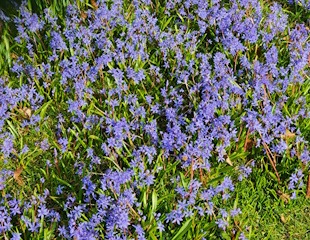
Special Features: Scilla are easy to grow, naturalise and multiply, creating carpets of blue in February and March. Also attractive to pollinators.
Scilla are beautiful spring-flowering bulbs that are easy to grow and perfect for attracting early pollinators. Scilla rewards with carpets of blue flowers in spring, illustrated above. Many gardeners grow Scilla for their delicate, blue, starry-shaped flowers, often with pretty white centres.
Personally, if you are looking for a reason to grow Scilla, it is their undeniable attraction to pollinators. Not just the odd passing bee, but masses of them, which makes Scilla an invaluable source of early nectar. Don't take my word for it, check out the short reel below.
The best varieties for attracting pollinators are
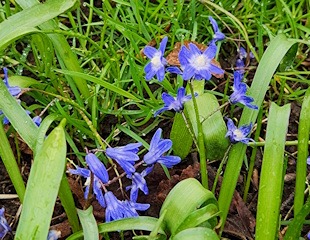
S. Siberica a deep blue illustrated above left and centre,
S. Siberica 'Alba', a white variety.
S. Mischtschenkoana ‘Misczenko Squill', pale blue
S.Chionodoxa forbesii illustrated above right;
all are fully hardy and good for bees.
I think Scilla perform better than crocuses (to which they are often compared.) Crocuses are Nyctinastic flowers, which means they only open fully in sunshine, which can be disappointing in a dull, overcast February. Scilla will bloom whatever the weather, which is one plus point. Once established, Scilla are drought resistant, useful as summer is their period of dormancy. After flowering, Scilla dies back and starts to re-grow in autumn.
How and when to Plant Scilla
Plant Scilla in mid to late Autumn. In common with all bulbs. Plant Scilla at a depth of 2/3 times the bulb's size. Scilla look most effective planted in groups and are ideal for planting under shrubs and trees, and with other early spring flowering bulbs. You can also grow Scilla in containers, and they are suitable for a gravel garden.
You may encounter Scilla growing in masses in churchyards where, for some reason, they seem to be popular.
Scilla Siberica a magnet for bees
I took this short reel at Launde Abbey Gardens ( a lovely place to visit), late in February, on a sunny day.
The image top right shows the approach, and at first I thought it was a carpet of Crocuses, but as I approached the patch of blue was humming. It was Scilla Siberica covered with all sorts of different types of bees and pollinators.