
Shrubs for Shade
All gardens have shady spots to a greater or lesser extent, and these areas require shrubs and plants that are shade tolerant. Shade is created by buildings, trees, fences and the garden's aspect. There are plenty of shade-loving shrubs, including evergreen, scented and flowering shrubs. You can create a low-maintenance shade-tolerant shrub border, or use the shrubs to create form and intersperse with shade-loving plants. This page brings together reliable shrubs for shady positions, with links to individual plant guides.
If you are looking for shrubs to plant in dry shade, check out ideas for plants and shrubs which are drought-tolerant.
Some shrubs listed here will grow in deeper shade, which is indicated.
Types of shade- what to look for?
There are different types of shade in the garden.
Full or dense shade: areas with minimal sunlight, such as a narrow pathway alongside a house or behind a garden structure.
Partial shade: this is usually an area which gets some sun, between 3-6 hours a day, as the sun moves around.
Dappled shade: light shade often caused by neighbouring trees or shrubs.
The shrubs listed below will grow in different degrees of shade.
Shrubs for dense shade
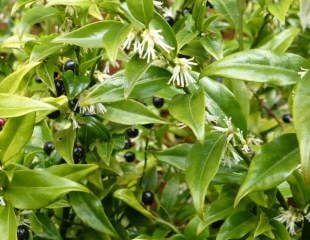
Sarcococca common name sweet box
Sarcococca is an evergreen shrub, winter flowering shrub, which is very easy to grow and thrives in dense shade. Varieties vary in size from around 1.5 m down to 0.5m a well-behaved garden shrub. More about growing Sarcococca
It has lovely glossy leaves and the bonus of sweetly scented flowers. Sarcococca is also tolerant of dry shade, such as under trees once established.
Fatsia
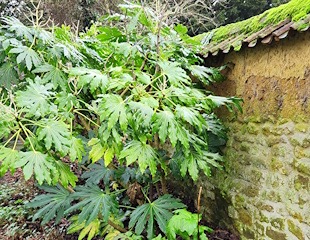
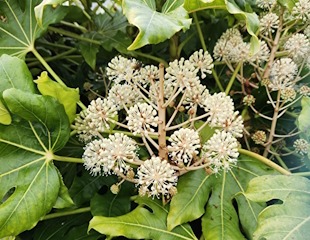
Fatsia is a Marmite shrub, love it or hate it, but either way, it will grow in full shade. It is evergreen, and the image shows the shrub flowering in Autumn. It is also called the caster oil shrub. This tough, fully hardy plant will reach around 2.5m at maturity.
It is easy to grow, to get the best showy leaves plant away from chilly winds.
Elaeagnus × ebbingei 'gilt edge'
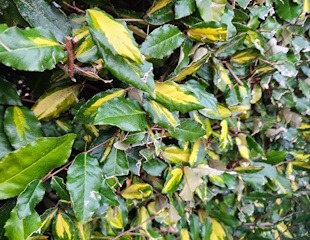
All varieties of Elaenagus will grow in partial shade, but this variety, Elaenagus ebbingei Gilt Edge, growing in shade has attractive variegated leaves.
Medium to fast growing it will reach a height of around 2m, growing more slowly in deep shade. It is fully hardy, a tough shrub and ideal for hedging in difficult areas.
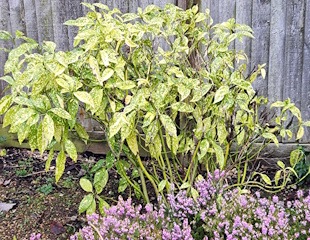
Spotted Laurel
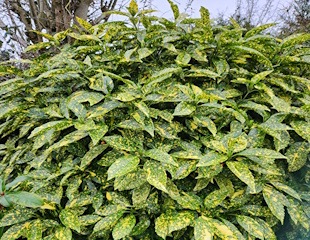
Aucuba japonica 'Variegata, the spotted laurel, with thrive even in deep shade. It has creamy white and green glossy leaves and may produce berries if there is a male shrub nearby.
It is easy to grow, relatively fast growing which makes it suitable for screening or hedging. Fully hardy, it requires very little attention other that (as with all shrubs) water during the first year to get established. It will grow in dry shade and is drought tolerant. Wet winters and poorly drained soil can cause it to look like the second image. Always plant in drier areas.
Shrubs for partial or dappled shade
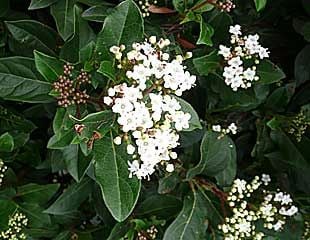
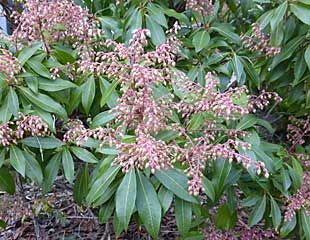
Viburnum tinus
Viburnum tinus has a lot going for it. It is fully evergreen and reaches about 2-4m depending on the growing conditions. It is H5 which means it will thrive in all sorts of growing conditions.
Viburnum tinus is has dark green leaves and it produces attractive flowers which start as pink buds and transforms into bright white blooms with a delightful fragrance. Viburnums flower in late winter and are low maintenance, tolerant of dappled shade, and will grow on any soil type.
There are other varieties of Viburnum which will grow in partial shade: Viburnum burkwoodii, Viburnum x carlcephalum, Viburnum x bodnantense 'Dawn', Viburnum davidii, and Viburnum opulus the Guelder rose. Generally Viburnum is easy to grow.
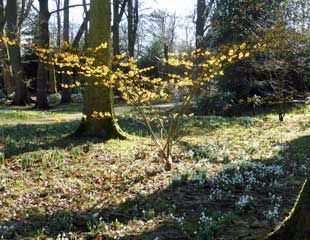
Hamamelis
Hamamelis is a winter flowering deciduous shrub/small tree which will provide winter colour. Flower colours are shades of yellow, orange, red with some mauve flowering varieties. Close up, the flowers are very attractive, spidery and usually scented.
Common name Witch Hazel, Hamamelis will tolerate light shade and look good as shown here in a woodland setting, under planted by late winter and early spring bulbs. The lovely bright flowers will shine out from a shady spot. Growing tips and images.
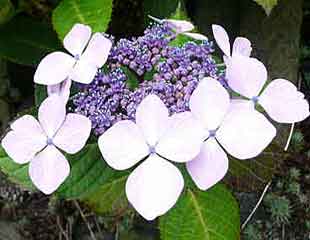
Hydrangea
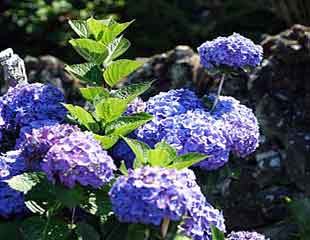
Excellent for growing in semi and dappled shade. Hydrangea are mostly summer flowering, deciduous shrubs which like shady conditions, cool areas and moist soil. There are several types of hydrangeas with a great range of colours, the images show the wide range of Hydrangea suitable for the garden and growing tips. Illustrated is a lace cap Hydrangea.

Climbing Hydrangea
The climbing Hydrangea, Hydrangea petiolaris, is ideal for growing in shade and will thrive grown on a north facing wall. It is a spring flowering, deciduous climbing plant which is self clinging and vigorous.
Easy to grow, it is a large climber which needs plenty of space but rewards with beautiful spring flowers.
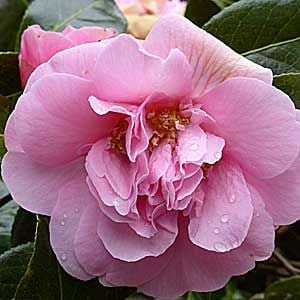
Camellia
Camellia is a spring flowering shrub, with large rose like flowers and glossy leaves. There are Camellias which will grow in partial shade and there is no doubt their showy blooms will light up the area.
Camellia is not straightforward to grow, and its important to plant them in the correct position. Check out if your shady area is suitable for a Camellia.
Suttons have a lovely selection of Camellias, in varying sizes and a wide range of colours. Browse their collection (affiliate link)

Skimmia japonica
Skimmia is a group of fully hardy, compact evergreen shrubs which grow well in shade and dislike sunny conditions.
Skimmia has lovely white flowers in the spring followed by red berries in autumn but only on the female varieties with the aid of a male plant nearby.
Once established, Skimmia requires no maintenance. They are slow growing and compact, making them ideal to grow in containers. More about growing Skimmia.
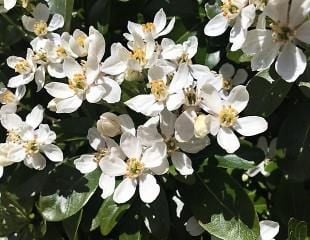
Choisya
One of my favourite shrubs, Choisya, ticks lots of boxes. It is fully hardy, evergreen with glossy leaves and wonderfully scented flowers in early summer. It is also easy to grow and makes a lovely addition to the border. There are two varieties commonly grown Choisya ' Aztec Pearl' illustrated also known as Mexican Orange Blossom, and C. ternata.
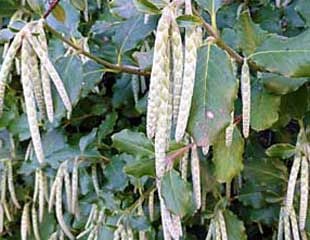
Garrya
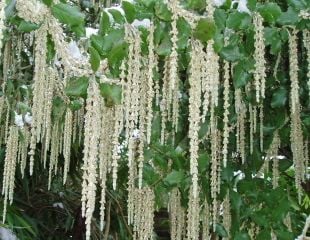
Garrya elliptica, common name Silk Tassel Bush, displays its lovely catkins in winter. It is easy to gro.
It is often described as not fully hardy including, the most commonly grown variety Garrya E. ' James Roof' I have seen Garrya growing in the northern parts of the UK and in cold eastern areas. Those locations provided the images on the page for growing Garrya. The trick is to plant it in a sheltered spot away from chilling winds.