How to Plant, Grow and Prune Holly Plants
Key Facts:
Height: variable from compact standard 3m to tall trees such as English holly 10m+, variety is key.
Light: sun through to shade
Soil: any provided it's not waterlogged.
If you are growing Hollies for berries, you need both sexes.
Special features: Hollies are grown for their attractive, usually variegated foliage and winter berries. Hollies are slow-growing tough shrubs which grow in any soil and conditions, although they tend to produce the best berries in the sun

Hollies are easy to grow, trouble free and so definitely a green wheelbarrow shrub.
Holly - Latin name Ilex, is a familiar, favourite garden shrub. Holly is an evergreen, slow-growing shrub, with bright variegated leaves and colourful berries.
We associate hollies with Christmas, and Holly is a good shrub for winter interest in a garden. Its foliage is excellent for use in a homemade Christmas wreath. The brightly variegated foliage and bright red berries will cheer up a dark corner. Plus, blackbirds, fieldfares, redwings and thrushes will eat the berries.
Holly is a useful shrub to plant in difficult areas as it is tough and, once planted, it usually thrives.
Many consider the fact that Holly is slow-growing a drawback. That's obviously the case if you are looking for fast growing evergreen shrubs, but sometimes having a slow-growing shrub is an advantage. It will remain compact in its allotted space for some time, not overwhelm the adjacent plants, and will not require pruning to contain it.
Ilex aquifolium is native to the UK and Europe. Shrubs vary in size from small compact varieties to large trees,
Before you plant Holly, be aware that the berries are toxic to cats, dogs and people- check out RHS list of poisonous plants.
Where to plant Holly
To achieve the best variegated foliage on the Holly, it should be planted in full sun or partial shade. Non-variegated varieties will survive in shade, even deep shade. Hollies look well in a shrub or woodland border, and also as a specimen shrub. Given that they are slow growing, buying a more mature specimen may be a good idea. There are many evergreen shrubs that are fast growing if you want to create a screen or privacy, but Holly is not one of them. It can take up to 20 -25 years for a Holly Shrub or Tree to reach maturity and full size. Slow growing can also be an advantage. If you have ever planted a shrub in an ideal spot only to discover within a couple of years or so it's getting too big for its allocated space, you will know then the dilemma of either moving it, or very regular pruning to keep it in check.
Hollies prefer soil to be on the moist side but well-drained, and are best planted late winter or early spring. They have the potential to be trained into a standard, which can look attractive in a mixed border. Hollies are also good to grow in a coastal garden and tolerate urban pollution.
Hollies self-seed around the garden as the birds consume the berries.
Hollies are suitable to make a wind-resistant hedge, and once planted, resent transplanting.
An easy, maintenance-free shrub. In terms of size and spread, many Hollies are large, 12- 20 metres is not uncommon. Most gardens will require something much smaller. There are a few compact varieties, such as 'Golden Gem' up to around 1 m, 'Wiesmoor Silber' 2.5m ; Ilex aquifolium Myrtifolia - is a compact Male Holly; Ilex aquifolium 'Hascombensis' compact 2.5m
How to get attractive berries on Hollies - you need both sexes
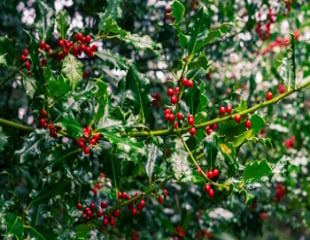
One of the main attractions of Hollies is the berries, with great winter interest. To get berries, it is necessary to have male and female plants, which might appear easy at first glance, but the names are very confusing. A popular variety, Golden King, is female, Golden Queen is male; similarly, Silver Milkmaid is male, which is all very confusing.
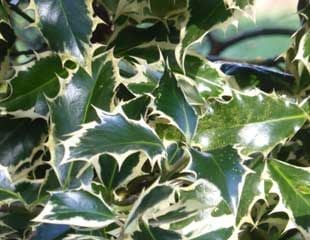
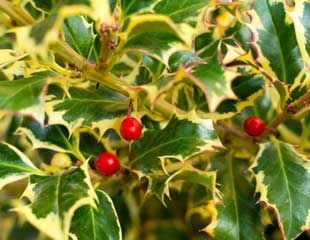
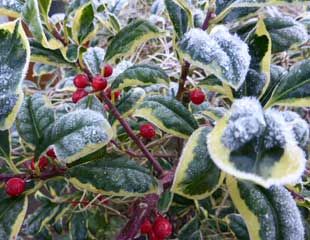
Because of the confusing nomenclature, the only way to be sure you are buying the correct sex of hollies for berries is to check the label/research or ask when buying the shrub to make sure you get a male and female variety. Illustrated above left is Ilex aquifolium 'Argentea marginata' which is a broad-leaved silver holly, (female) which is a popular variety widely available. A male shrub needs to be planted nearby for it to produce berries. Illustrated above centre is Ilex × altaclerensis 'Golden King', which is also female. A self-fertile variety is J.C van Tol, attractive berries, although without the spikey leaves.
Another good reason to grow Holly with berries is that the foliage is excellent for making your own Christmas Wreath.
Hollies are good in a wildlife garden as the berries providing an invaluable food source. Great winter colour in the variegated foliage, and you can bring it in to decorate the house.
Holly shrubs with berries are always popular with garden birds.
How to Prune Holly
The slow growing nature of Holly means that pruning is not essential.
However, should you want to prune Holly, timing is key to preserve as many potential berries for next year. This is a question of balance between how much you prune and how many berries appear the following winter. You should prune between late winter to early spring, up to around the beginning of April.
Holly flowers, and berries are produced on "old wood", which means whilst the safest time to prune holly is in the dormant season, you will remove some wood which has potential flowers (and later berries,) on it. The best compromise is to prune lightly, and if a more pruning is needed remove, say, one third of the stems, so pruning takes place over 3 years. This will result in some branches being pruned each year, and some not, so some berries are spared.
Holly will survive a hard prune, cutting back to main stems if necessary. Hard pruning should always be undertaken in late winter.Pruning hard will result in much reduced berries the following season and then the berries should return.
Remember also, if you cut branches to bring in doors for Christmas, you are in effect pruning the Holly.
What to do about Holly leaf Miner Pest
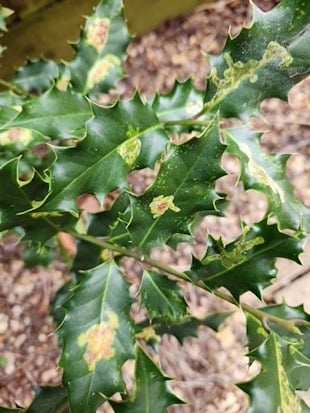
If your Holly looks like this, do not worry. The Holly Leaf Miner Pest, unsightly but not fatal, causes the blotches.
To improve appearance, you can remove leaves when the pest first strikes, but as you see from the image on the left, there are too many leaves afflicted.
The shrub next to it, now removed, likely made it susceptible by overshadowing and reducing its share of light exposure. Now that shrub has been removed, I am hoping the Holly will make a steady recovery. If it does not the standard remedy for controlling leaf miners is Neem oil.